






Kontaktieren Sie uns
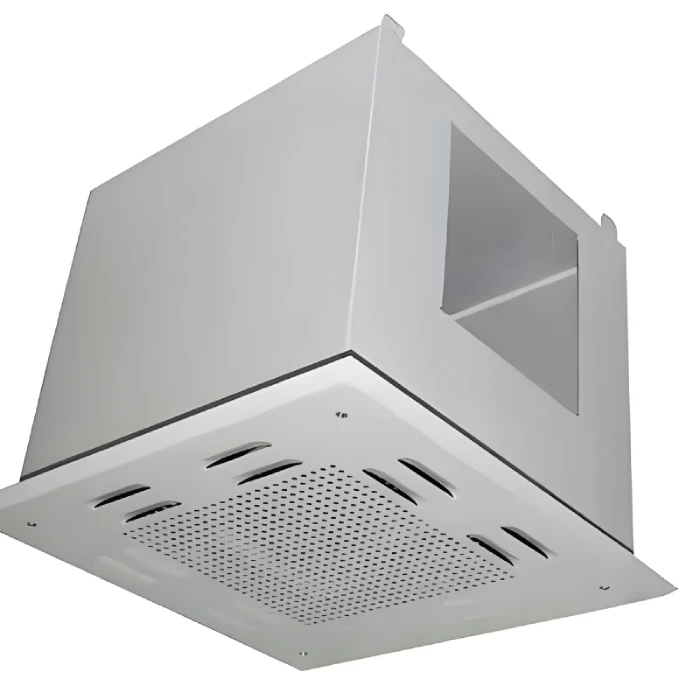
Hohe Effizienz Luftauslass
Übersicht:
Der High Efficiency Air Outlet, auch als HEPA Air Outlet bekannt, ist ein Endluftversorgungsgerät in Reinraum-HVAC-Reinigungssystemen. Auf der Reinraum-Decke installiert, beherbergt es einen hocheffizienten Filter und liefert behandelte saubere Luft gleichmäßig in den Reinraum. Es ist einer der Schlüsselkomponenten für die Aufrechterhaltung der Reinraum-Sauberkeit. Hocheffiziente Luftausläufe werden in der Regel in Verbindung mit Kanalsystemen und Luftbehandlungseinheiten verwendet. Sie eignen sich für Reinraum-Umgebungen von ISO-Klasse 5 bis ISO-Klasse 8 und sind weit verbreitet in der Pharma-, Biotechnologie-, Elektronikherstellung-, Krankenhaus- und Lebensmittelverarbeitungsindustrie.
Schlüsselwörter:
DETAIL:
1. Product Overview
Der High Efficiency Air Outlet, auch als HEPA Air Outlet bekannt, ist ein Endluftversorgungsgerät in Reinraum-HVAC-Reinigungssystemen. Auf der Reinraum-Decke installiert, beherbergt es einen hocheffizienten Filter und liefert behandelte saubere Luft gleichmäßig in den Reinraum. Es ist einer der Schlüsselkomponenten für die Aufrechterhaltung der Reinraum-Sauberkeit.
High Efficiency Air Outlets are typically used in conjunction with duct systems and air handling units. They are suitable for cleanroom environments ranging from ISO Class 5 to ISO Class 8 and are widely used in pharmaceutical, biotechnology, electronics manufacturing, hospital, and food processing industries.
2. Arbeitsprinzip
The working principle of the High Efficiency Air Outlet is based on a combination of centralized air supply and terminal filtration.
First, Air Source Supply. A central air handling unit or fan provides air that has passed through preliminary and medium-efficiency filters. This air is delivered to each High Efficiency Air Outlet through supply ducts.
Second, Terminal Filtration. Air enters the High Efficiency Air Outlet and passes through the built-in HEPA or ULPA filter, where airborne particles, bacteria, dust, and other contaminants are efficiently captured.
Drittens: Einheitliche Luftversorgung. Die gefilterte Reinluft tritt am Auslass durch die Diffusorplatte oder Luftströmungsgleichmäßigereinrichtung und wird mit gleichmäßiger Geschwindigkeit und Richtung in den Reinraum zugeführt, wodurch das erforderliche Luftströmungsmuster entsteht.
Fourth, Pressure Differential Maintenance. The High Efficiency Air Outlet works together with return air outlets to establish and maintain the required pressure differential gradient within the cleanroom, preventing contaminants from migrating from lower cleanliness areas to higher cleanliness areas.
3. Product Structure and Components
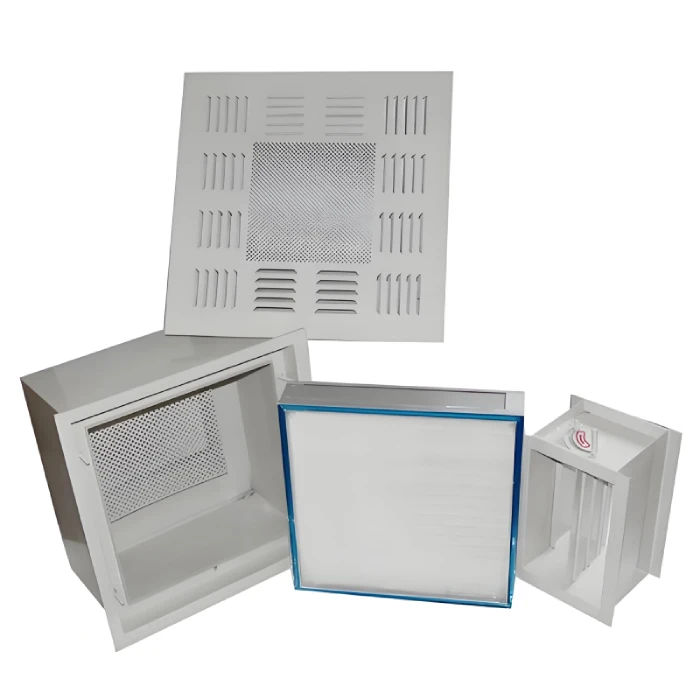
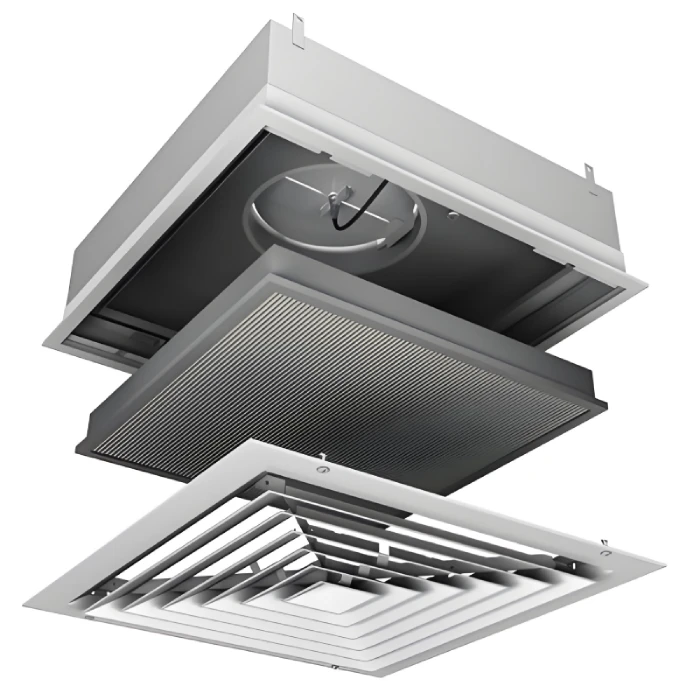
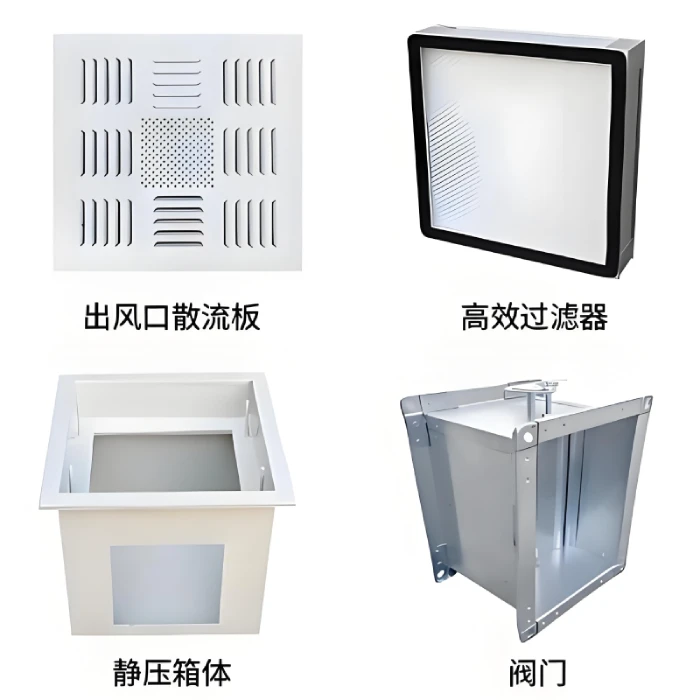
The High Efficiency Air Outlet consists of the following core components:
Housing: Manufactured from high-quality cold-rolled steel sheet or stainless steel sheet, with electrostatic spray or powder coating finish for good corrosion resistance and aesthetic appearance. The housing is designed to be airtight.
High Efficiency Filter: The core filtration component, including HEPA filters (99.97% or higher efficiency for 0.3 micron particles) and ULPA filters (99.999% or higher efficiency for 0.12 micron particles). Filters can be of the separated or mini-pleat type.
Diffuser Plate: Installed at the air outlet face, typically made of aluminum alloy or stainless steel, with uniformly distributed small holes or slots to ensure even distribution of supplied air.
Air Volume Control Damper: Installed at the air inlet end of the outlet, used to adjust the air volume delivered into the cleanroom, allowing adjustment of air change rates and pressure differential based on actual requirements.
Sealing Device: Includes sealing gaskets between the housing and the ceiling, and sealing strips between the filter and the housing, ensuring the system is airtight.
Pressure Differential Test Port: Used to connect a pressure gauge, facilitating monitoring of filter resistance changes to determine when filter replacement is needed.
Insulation Layer: Some models have an insulation layer on the exterior of the housing to prevent condensation during air conditioning operation.
4. Features and Advantages
First, High Filtration Efficiency. Built-in HEPA or ULPA filters efficiently remove microscopic airborne particles, ensuring supply air cleanliness meets cleanroom requirements.
Second, Uniform Air Distribution. Optimized diffuser plate design provides uniform and stable air supply, minimizing turbulence and dead zones, helping maintain cleanroom cleanliness.
Third, Compact Structure. The housing is compact, occupying minimal ceiling space, suitable for buildings with limited overhead space.
Fourth, Easy Installation. Standardized interface dimensions and installation methods allow direct connection to common duct systems, making installation quick and simple.
Fifth, Convenient Maintenance. Filters can be replaced from inside the cleanroom or from above the ceiling. Some models feature side-pull or bottom-pull designs for simple replacement.
Sixth, Adjustable Air Volume. Equipped with an air volume control damper, allowing flexible adjustment of supply air volume based on actual cleanroom requirements.
Seventh, Good Sealing Performance. Multiple sealing designs ensure system airtightness, preventing unfiltered air from leaking into the cleanroom through gaps.
Eighth, High Quality Materials. The housing is manufactured from high-quality steel with advanced surface treatment, offering corrosion resistance, easy cleaning, aesthetic appearance, and durability.
5. Technical Specifications (Standard)
Housing Material: Cold-rolled steel sheet or stainless steel sheet (304 or 316L)
Surface Finish: Electrostatic spray coating or powder coating
Standard Dimensions (Width × Height × Depth): Various standard sizes available, such as 600×600×500mm, 750×750×500mm, 900×600×500mm, and customizable
High Efficiency Filter Type: HEPA filter or ULPA filter
HEPA Filtration Efficiency: 99.97% or higher for 0.3 micron particles
ULPA Filtrationseffizienz: 99,999% oder höher für 0,12 Mikron Partikel
Nenntluftstrom: 500 bis 3000 Kubikmeter pro Stunde (variiert je nach Größe und Modell)
Face Velocity: 0.45 to 1.5 meters per second (adjustable)
Diffusorplattenmaterial: Aluminiumlegierung oder Edelstahl
Air Volume Control Damper: Opposed blade multi-leaf damper or single-leaf damper
Dichtungsmethode: Dichtungsdichtung oder Geldichtung
Betriebstemperatur: 0 bis 40 Grad Celsius
Operating Humidity: Less than 95% relative humidity
Installation Method: Recessed ceiling-mounted
6. Produktklassifizierung
Nach Filtertyp: HEPA High Efficiency Air Outlet, ausgestattet mit HEPA-Filter, geeignet für herkömmliche Reinraum-Umgebungen. ULPA High Efficiency Air Outlet, ausgestattet mit ULPA Filter, geeignet für höhere Reinigungsanforderungen über ISO Klasse 5.
Nach Material: Kohlenstoffstahl High Efficiency Air Outlet, Gehäuse aus kaltgewalztem Stahl mit Pulverbeschichtung, wirtschaftlich und praktisch. Edelstahl High Efficiency Air Outlet, Gehäuse aus Edelstahl 304 oder 316L, hochkorrosionsbeständig, geeignet für feuchte oder korrosive Umgebungen.
By Installation Method: Ceiling Supply Type, standard installation with air supplied downward from ceiling. Side Supply Type, wall-mounted, suitable for special airflow pattern requirements.
By Diffuser Type: Perforated Plate Diffuser, featuring uniformly distributed round holes for even air dispersion. Louvered Diffuser, featuring adjustable louvers for airflow direction control.
By Sealing Method: Gasket Seal Type, using sealing gasket between filter and housing, lower cost. Gel Seal Type, using gel seal technology for superior airtightness, suitable for applications with extremely high sealing requirements.
By Insulation: Non-Insulated Type, without insulation layer. Insulated Type, with insulation layer on housing exterior to prevent condensation.
7. Application Areas
High Efficiency Air Outlets are widely used in various locations with strict air cleanliness requirements.
Pharmaceutical Industry: Used in drug production workshops, sterile preparation workshops, API purification and packaging workshops, quality control laboratories, complying with GMP requirements. High Efficiency Air Outlets provide clean air to ensure air quality during pharmaceutical production meets specified standards.
Biotechnology and Life Sciences: Used in biological laboratories, cell culture rooms, genetic laboratories, microbiology testing rooms, etc., preventing airborne microorganisms and particles from contaminating experimental samples and cultures.
Halbleiter- und Elektronikherstellung: Verwendet in Chipfertigungswerkstätten, Wafer-Verarbeitungsbereichen, LCD-Panel-Produktionswerkstätten, Präzisionsmontagelinien für elektronische Komponenten usw., die Luftumgebungen mit hoher Reinheit bieten, um zu verhindern, dass mikroskopische Partikel Mängel in elektronischen Komponenten verursachen.
Hospitals and Medical Facilities: Used in operating rooms, ICU wards, sterile treatment rooms, central sterile supply departments, isolation wards, etc. High Efficiency Air Outlets provide clean air to reduce hospital infection risks and protect patients and medical staff.
Food and Beverage Processing: Used in food packaging workshops, dairy filling lines, beverage production workshops, meat processing workshops, etc., preventing airborne microorganisms from contaminating food products and extending product shelf life.
Precision Instruments and Optics Manufacturing: Used in lens assembly workshops, precision instrument calibration rooms, optical coating workshops, etc., providing dust-free environments to protect precision instruments and optical components from contamination.
Laboratories and R&D Centers: Used in chemical laboratories, physics laboratories, materials science laboratories, analytical testing centers, etc., protecting experimental samples and precision instruments from airborne particle interference.
Medical Device Manufacturing: Used in medical device production workshops, implant manufacturing workshops, single-use sterile device packaging workshops, etc., ensuring products are not contaminated by microorganisms during production.
Cosmetics Production: Used in cosmetics filling workshops, emulsifying workshops, packaging workshops, etc., preventing airborne microorganisms from contaminating cosmetics and ensuring product quality and safety.
Data Centers and Computer Rooms: Used in server rooms, telecommunications rooms, control centers, etc. High Efficiency Air Outlets help maintain the clean environment and temperature control required for equipment operation.
Animal Housing Facilities: Used in SPF animal rooms, laboratory animal centers, animal operating rooms, etc., preventing airborne pathogens from entering animal housing areas and protecting the health of laboratory animals.
Luft- und Raumfahrt und Verteidigung: Verwendet in Raumfahrzeugmontagewerkstätten, Präzisionsnavigationsgeräteherstellungswerkstätten, Wartungswerkstätten für Waffensysteme und anderen Anwendungen mit speziellen Reinigungsanforderungen.
8. Vergleich mit anderen Reinraumausrüstungen
High Efficiency Air Outlet vs. FFU: Der High Efficiency Air Outlet enthält keinen integrierten Ventilator und setzt für die Luftversorgung auf ein zentrales HVAC-System. FFUs verfügen über einen eingebauten Lüfter und können unabhängig arbeiten. High Efficiency Air Outlets eignen sich für neue Großraumprojekte mit geringeren Anfangsinvestitionen. FFUs eignen sich für Renovierungsprojekte und Anwendungen, die eine unabhängige Luftströmungssteuerung erfordern.
High Efficiency Air Outlet vs. Fan Filter Box: Fan filter boxes typically include both fan and filter as a complete air supply unit. The High Efficiency Air Outlet is only a terminal device and requires an external fan for operation. High Efficiency Air Outlets have a simpler structure and lower maintenance costs.
High Efficiency Air Outlet vs. Standard Diffuser: Standard diffusers do not have filtration capability and only serve to distribute airflow. The High Efficiency Air Outlet provides both diffusion and high-efficiency filtration, making it a dedicated air supply device for cleanrooms.
9. Selection Guide
Reinigungsanforderungen: Wählen Sie den entsprechenden High Efficiency Air Outlet basierend auf der erforderlichen ISO-Reinigungsklasse aus. Für ISO Klasse 5 und höher werden ULPA-Filter empfohlen. Für ISO Klasse 6 bis Klasse 8 sind HEPA-Filter geeignet.
Luftstromanforderung: Berechnen Sie das Gesamtzufuhrluftvolumen basierend auf Reinraumfläche, Höhe und erforderlicher Luftwechselrate. Bestimmen Sie die Anzahl der benötigten Luftausläufe mit hoher Effizienz und den Nennluftstrom pro Auslass.
Installationsraum: Messen Sie die Deckenhöhe und wählen Sie ein Gehäuse der entsprechenden Höhe aus. Für begrenzten Platz wählen Sie einen Low-Profile High Efficiency Air Outlet.
Materialauswahl: Für normale trockene Umgebungen ist Kohlenstoffstahl mit Pulverbeschichtung geeignet. Für feuchte Umgebungen oder Orte mit korrosiven Gasen wählen Sie ein Gehäuse aus Edelstahl.
Dichtungsanforderung: Für Anwendungen mit hohen Luftdichtheitsanforderungen (wie Biosicherheitslabors, sterile pharmazeutische Werkstätten) werden Geldichtungen des Typs High Efficiency Air Outlets empfohlen.
Diffuser Type: For applications requiring high airflow uniformity, choose perforated plate diffusers. For applications requiring adjustable airflow direction, choose louvered diffusers.
Maintenance Convenience: Consider the workspace available for filter replacement and select a model that can be serviced from inside the cleanroom or from above the ceiling.
Compliance Requirements: The pharmaceutical industry should select High Efficiency Air Outlets that comply with GMP requirements, typically requiring material certificates and factory test reports.
10. Installation und Wartung
Schlüsselpunkte der Installation: Überprüfen Sie vor der Installation, ob die Abmessungen der Deckenöffnung mit dem Luftaustritt übereinstimmen. Installieren Sie Versorgungskanäle im Deckenraum, um eine gute Kanaldichtung zu gewährleisten. Stecken Sie das High Efficiency Air Outlet Gehäuse in die Deckenöffnung ein, indem Sie Dichtungsdichtungen verwenden, um gegen die Decke zu dichten. Verbinden Sie den Zufuhrkanal mit dem Luftaustrittseinlass, indem Sie Flansche und Dichtungsdichtungen verwenden, um leckfreie Verbindungen zu gewährleisten. Installieren Sie den hocheffizienten Filter, um eine korrekte Orientierung und eine ordnungsgemäße Dichtung zu gewährleisten. Installieren Sie die Diffusorplatte. Anschließen Sie das Druckdifferenzprüfrohr. Durchführen Sie die Inbetriebnahme des Systems, um das Luftversorgungsvolumen und die Druckdifferenz zu testen.
Filteraustauschverfahren: Schalten Sie das HVAC-System aus oder schließen Sie den entsprechenden Luftaustrittsdämpfer. Entfernen Sie die Diffusorplatte. Entfernen Sie den alten Filter aus dem Gehäuse. Reinigen Sie den Filtermontagerahmen und die Dichtflächen. Installieren Sie den neuen Filter, um sicherzustellen, dass die Dichtung gleichmäßig komprimiert ist. Installieren Sie die Diffusorplatte wieder. Starten Sie das System neu und führen Sie Luftstromgeschwindigkeits- und Druckdifferenztests durch. Notieren Sie das Datum des Filteraustauschs und die Druckdifferenzlesung.
Tägliche Wartung: Beobachten Sie regelmäßig den Druckmessmesswert. Wenn die Druckdifferenz den doppelten Anfangswiderstand erreicht, ist ein Filteraustausch erforderlich. Reinigen Sie die Diffusorplattenoberfläche regelmäßig, um zu verhindern, dass sich Staub ansammelt und die Luftströmungsverteilung beeinflusst. Überprüfen Sie Dichtpunkte auf Luftleckage. Durchführen Sie regelmäßig Luftstromgeschwindigkeitsprüfungen, um sicherzustellen, dass das Zuluftvolumen die Konstruktionsanforderungen erfüllt. Durchführen Sie regelmäßig Filterintegritätsprüfungen (PAO-Leckagetest), um keine Filterleckage zu überprüfen.
Common Troubleshooting: If supply air volume is insufficient, check whether the air volume control damper is fully open, whether the filter is clogged, or whether the supply duct is leaking. If air supply is uneven, check whether the diffuser plate is clogged or improperly leveled. If pressure differential is too high, the filter is clogged and requires replacement. If condensation occurs on the housing, check whether the insulation layer is intact or whether the supply air temperature is too low.
Häufig gestellte Fragen
- 1 Wie verbessern Doppelglasfensterscheiben die Reinraumleistung in Lithographiebereichen?
- 2 Welche Branchen verwenden FFUs?
- 3 Was ist eine Fan Filter Unit (FFU)?
- 4 Was ist die Funktion eines Clean Booths im Einrichtungsdesign?
- 5 Wie verwalten Air Shower Rooms Personalentrittsprotokolle?
- 6 Welche Lösungen gibt es für die Dekontamination großer Güter?
- 7 Wie wird die Luftverteilung in Reinraumsystemen verwaltet?
- 8 Was definiert die Klassifizierung eines Clean Booth Systems?
- 9 Wie verbessert ein Luftduschraum die Kontaminationskontrolle?
- 10 Wie kann die Luftströmungskonsistenz in modularen Reinzonen erhalten werden?
1
Wie verbessern Doppelglasfensterscheiben die Reinraumleistung in Lithographiebereichen?
Double glass panes bieten kritische thermische, akustische und partikuläre Isolation. Die versiegelte Argon- oder Kryptonfüllung minimiert konvektive Ströme am Viewport— Verhinderung lokaler Turbulenzen, die den laminaren Fluss stören könnten. Leitfähige Beschichtungen ermöglichen eine statische Ableitung, während die laminierte Konstruktion die Anforderungen an Schlag- und Brandschutz erfüllt. In der Praxis reduzieren sie den Eintritt von Partikeln durch Beobachtungspunkte um > 90% im Vergleich zu Single-Panel-Alternativen und unterstützen stabile Differenzdrücke über die Grenzen der ISO-Klasse 3/4 hinweg.
2
Welche Branchen verwenden FFUs?
Halbleiterproduktionslinien (partikelempfindlich), biomedizinische Forschungslabors, pharmazeutische Fertigung und jede kontrollierte Umgebung, die eine präzise Luftströmung, Geschwindigkeit und Lärmpegel erfordert.
3
Was ist eine Fan Filter Unit (FFU)?
Eine FFU ist ein modulares Luftreinigungsgerät, das einen Lüfter mit HEPA- oder ULPA-Filtern in einem einzigen Gehäuse kombiniert. Es bietet eine lokalisierte saubere Luftversorgung und ist von grundlegender Bedeutung für die Kontaminationskontrolle im Reinraum.
4
Was ist die Funktion eines Clean Booths im Einrichtungsdesign?
Ein Clean Booth bietet eine lokalisierte saubere Umgebung in einem größeren Raum. Es verwendet eine Cleanroom Fan Filter Unit(FFU) zum Aufrechterhalten des positiven Drucks und zum Filtern von Luftpartikeln. Diese Art von Cleanroom Local Clean Equipment ist für Prozesse unerlässlich, die ISO-Klasse 5 oder bessere Bedingungen erfordern, ohne einen vollständigen Cleanroom zu bauen. Die Installation ist flexibel und kostengünstig für bestimmte Arbeitsplätze, die eine Kontaminationskontrolle erfordern.
5
Wie verwalten Air Shower Rooms Personalentrittsprotokolle?
Personaleinreise erfordert strenge Dekontamination. Ein cleanroom Single-Person Air Shower Room ist für den individuellen Zugang konzipiert, während ein cleanroom Multi-Person Air Shower Room höhere Verkehrsvolumen bewältigt. Der allgemeine Cleanroom Air Shower Room verwendet Hochgeschwindigkeitsluft, um Partikel aus der Kleidung zu entfernen, bevor sie kritische Zonen betreten. Die richtigen Verriegelungssysteme sorgen dafür, dass sich die Türen nicht gleichzeitig öffnen und die Druckdifferenzen und die Reinigungsnormen effektiv aufrechterhalten.
6
Welche Lösungen gibt es für die Dekontamination großer Güter?
Große Gegenstände erfordern spezialisierte Dekontaminationskanäle. Ein Cleanroom Cargo Air Duschraum bietet Platz für Paletten und große Geräte, die in die Anlage eintreten. Der kontinuierliche Fluss wird über einen Cleanroom Goods Air Shower Tunnel für die Volumenlogistik verwaltet. Kleinere Gegenstände passieren durch eine Reinraum Aluminium Pass Box, die Haltbarkeit und Korrosionsbeständigkeit bietet. Diese Systeme verhindern, dass externe Schadstoffe die innere Umwelt während des Materialtransports beeinträchtigen.
7
Wie wird die Luftverteilung in Reinraumsystemen verwaltet?
Die Luftverteilung bestimmt das Reinigungsniveau. Das Reinraum Luftversorgungsgerät regelt Volumen und Druck im Raum. Die gefilterte Luft wird durch einen Cleanroom High Efficiency Air Outlet dispergiert, um eine gleichmäßige Abdeckung ohne Turbulenzen zu gewährleisten. Modulare Setups nutzen häufig einen Cleanroom Clean Panel Clean Booth, um diese Komponenten nahtlos zu integrieren. Die richtige Konstruktion gewährleistet konsistente Luftwechsel pro Stunde, um die gesetzlichen Compliance-Standards zu erfüllen.
8
Was definiert die Klassifizierung eines Clean Booth Systems?
Die Klassifizierung hängt von der Luftreinigkeit ab. Ein Clean Booth bietet lokalisierte ISO-Klasse 5-Umgebungen. Die Integration mit einer Cleanroom Fan Filter Unit(FFU) gewährleistet einen konsistenten Luftstrom. Die regelmäßige Wartung des High Efficiency Air Outlet im Reinraum ist entscheidend für die Einhaltung der Partikelkontrollstandards im Arbeitsraum.
9
Wie verbessert ein Luftduschraum die Kontaminationskontrolle?
Personaleinreise erfordert strenge Dekontamination. Ein cleanroom Single-Person-Luftduschraum entfernt Partikel aus Anzügen vor dem Eintritt. Für größere Gruppen erhöht ein cleanroom Multi-Person Air Shower Room effizient den Durchsatz. Der Frachttransport nutzt einen „Reinraum“ Cargo Air Duschraum, um zu verhindern, dass äußere Schadstoffe während des Materialtransfers in kritische Produktionszonen gelangen.
10
Wie kann die Luftströmungskonsistenz in modularen Reinzonen erhalten werden?
Die Aufrechterhaltung eines richtigen Luftstroms ist für die Kontaminationskontrolle von entscheidender Bedeutung. Die Cleanroom Fan Filter Unit(FFU) gewährleistet eine gleichmäßige Verteilung über den Arbeitsraum hinweg. Die Integration mit einem Cleanroom Clean Booth bietet eine lokalisierte ISO Class 5 Umgebung. Darüber hinaus hilft die Installation eines Cleanroom High Efficiency Air Outlets, Abgas- und Druckdifferenzen effektiv zu verwalten. Regelmäßige Filterprüfungen sind notwendig, um die Leistungsstandards aufrechtzuerhalten, ohne die Betriebsintegrität zu beeinträchtigen.